


Finally, Relief From Sleepless Nights In Just 30 Days
Built on PEMF and sound frequencies studied in double-blind clinical trials. Not a pill. Not a supplement. It works on the wired nervous system that is actually keeping you awake.
- 7 in 10 no longer had clinical insomnia after 4 weeks
- 81% fell asleep within 30 minutes
- Drug-free. No morning grogginess, no dependency
 Dr. Sarah Mitchell
Sleep Research Consultant
Dr. Sarah Mitchell
Sleep Research Consultant
The biggest mistake people make is trying to force sleep. Deep sleep starts when the brain shifts into a relaxed state. Consistent calming routines often matter more than simply spending more hours in bed.
 Dr. Emily Carter
Neuroscientist & Sleep Research Consultant
Dr. Emily Carter
Neuroscientist & Sleep Research Consultant
Deep, restorative sleep starts long before your head hits the pillow. Creating the right conditions for your brain to unwind is often more effective than simply trying harder to fall asleep.
 Dr. Michael Foster
Behavioral Sleep Specialist
Dr. Michael Foster
Behavioral Sleep Specialist
Many sleep products only mask the symptoms. Long-term improvement comes from helping your nervous system transition naturally from alertness into rest.
Everything you get today
-
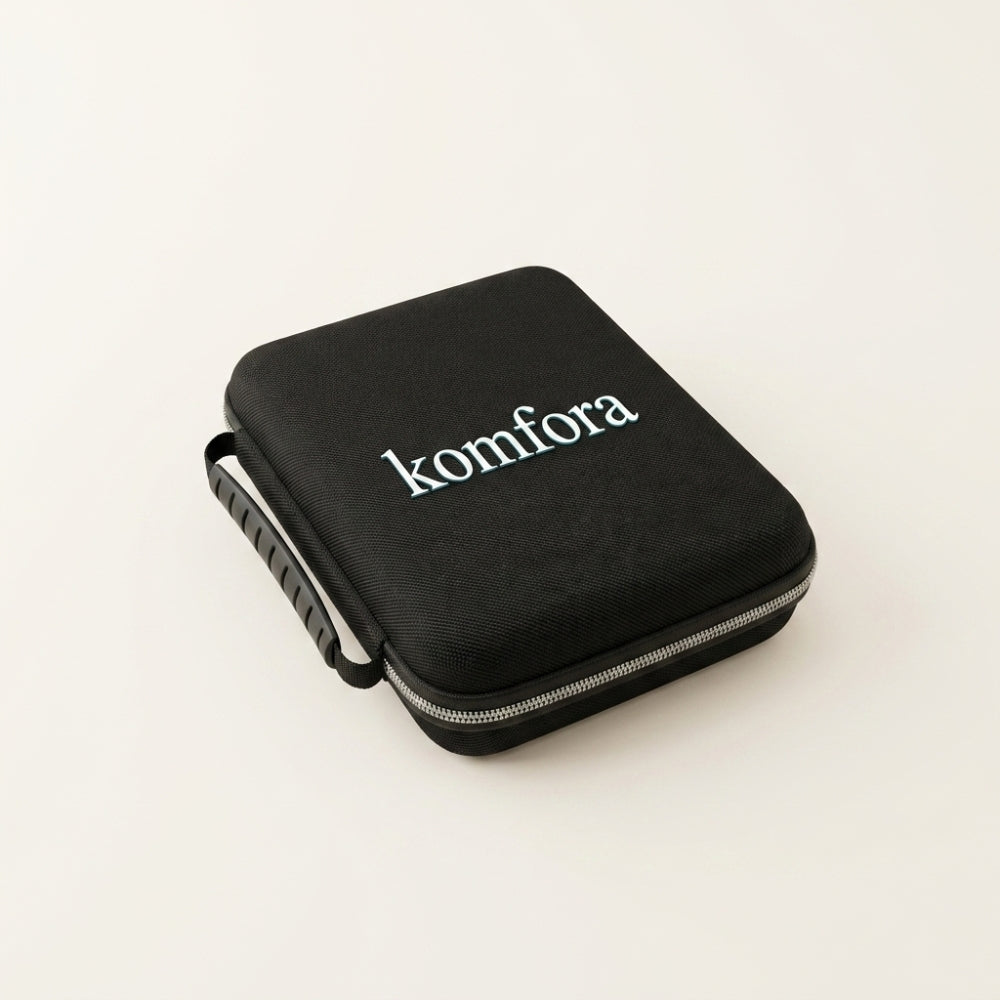
 Komfora Travel Case
The device itself
$29.00
Komfora Travel Case
The device itself
$29.00
-
 Premium Sleep Ear-Tips
Included free
Premium Sleep Ear-Tips
Included free
$19.00FREE -
 Relieve Insomnia in 30 Days (E-Book)
Included free
Relieve Insomnia in 30 Days (E-Book)
Included free
$27.00FREE -
Komfora Travel Case
Included free
$29.00FREE


You save $75.00 72% off
Couldn't load pickup availability
Clinical Studies
PEMF for insomnia. A double-blind, placebo-controlled randomised trial in 153 adults. After 4 weeks, 7 in 10 no longer met the criteria for clinical insomnia, against 35% on placebo. Read the study (Psychiatry Investigation, 2023)
Acoustic stimulation. Alpha phase-locked sound helped 81% of participants fall asleep within 30 minutes, compared with 50% without it. Read the study (Scientific Reports, 2024)
Binaural beats and deep sleep. On the night of the beat, the listeners spent 23% more of their sleep in deep sleep than the silent control group. Read the study (Frontiers in Human Neuroscience, 2018)
Meta-analysis. Eight trials, 419 people: acoustic stimulation significantly improved insomnia severity. Read the meta-analysis (Frontiers in Neuroscience, 2025)
These studies test the frequencies Komfora uses. They are not trials of this device.
What's Included
- The Komfora device. PEMF plus sound, in one 20 minute session.
- Premium sleep ear-tips. Low profile, built to stay comfortable when you fall asleep on your side. $19 value, free.
- Relieve Insomnia in 30 Days. The e-book protocol that pairs with the device. $27 value, free.
- Komfora Travel Case. A rigid zip case so it travels with you. $29 value, free.
- 30-day money-back guarantee. Thirty nights to decide.
- 1-year-warranty on the Komfora Sleep System.
How To Use
One evening ritual, twenty minutes.
- Put it on. Device and ear-tips, in bed, lights low.
- Press play. Pick the deep-sleep mode. That is the only choice you make.
- Drift. The PEMF pulse settles your nervous system while the delta and theta frequencies guide your brainwaves toward deep sleep.
No app to configure, no routine to remember. If you fall asleep before it ends, it switches itself off.
Shipping & Returns
Free shipping on every order. Orders are processed in 1 to 3 days and arrive within 5 to 8 business days.
Not sleeping better after thirty nights of following the protocol? Email us within 30 days of delivery and we will refund you. See our refund policy.
Our 30-Day Guarantee
The clinical trials ran for four weeks. Our e-book protocol runs for 30 days. So the guarantee is 30 days too. That is not a marketing number, it is the same window the research used.
If your nights have not changed by then, we refund every cent.

It is 3am. Your body is exhausted. Your brain is wide awake.
You did everything right. Lights off at eleven. No screens. The magnesium, the melatonin, the tea that promised calm. And still, at three in the morning, your heart is going and your mind is running the same loop it ran last night.
Here is what nobody told you: you are not failing at sleep. Your nervous system is stuck in a wired state, and no amount of timing hormones will switch it off.
- "my brain won't shut off"
- "tired but wired"
- "I've tried everything"
- "wide awake at 3am"
- "running on empty"
The problem was never when you sleep. It is that your brain will not stand down.
A different mechanism, not another sleep aid
Pills work on timing or sedation. DeltaDrift™ works on the state your brain is stuck in. One 20 minute session, two things happening at once.

-
01
It calms the wired nervous system
The PEMF pulse settles an over-activated nervous system. That wired, humming, cannot-stand-down state is exactly what keeps you staring at the ceiling. This is the part melatonin never touches.
-
02
It guides your brainwaves toward deep sleep
Delta and theta sound frequencies pull your brainwaves toward the rhythms of deep, restorative sleep. Not knocked out. Drifting, the way sleep is supposed to arrive.
Komfora runs in deep-sleep mode: a low PEMF pulse around 1 Hz alongside delta and theta frequencies between 0.5 and 4 Hz. Those are the ranges used in the sleep research, not a number picked because it sounds meaningful.
The research behind the frequencies
Not testimonials. Not a founder's hunch. Peer-reviewed trials measuring what these frequencies do to sleep.
no longer had clinical insomnia after 4 weeks, against 35% on placebo

fell asleep within 30 minutes, compared with 50% without the sound

more of the night spent in deep sleep than the silent control group

These studies test the frequencies Komfora uses. They are not trials of this device. We think that distinction matters, so we make it here rather than bury it.
Fall asleep in 30 minutes within 30 days, or your money back
The trials ran for four weeks. Our protocol runs for 30 days. So the guarantee is 30 days too, and that is not a marketing number, it is the same window the research used.
Give it thirty nights, following the protocol. If your sleep has not changed, email us within 30 days of delivery and we will refund you. The conditions are in our refund policy.
- Fall asleep faster: 81% were under in 30 minutes, against 50% without
- Sleep deeper: 23% more deep sleep than the control group
- 7 in 10 no longer had clinical insomnia after four weeks
- Keep the ear-tips and the e-book either way
Twenty minutes. Three steps. That is the whole routine.
No app to configure. No protocol to memorise. Nothing to remember at 3am, which is exactly when you have the least capacity to remember anything.
-
 1
1
Put it on
Device and ear-tips, in bed, lights already low. The ear-tips are built to stay comfortable if you sleep on your side.
-
 2
2
Press play
Pick deep-sleep mode. That is the only decision you make all evening.
-
 3
3
Drift
The pulse settles your nervous system while the frequencies pull your brainwaves toward deep sleep. You do not have to do anything.


If you fall asleep before it ends, it switches itself off.
You were not doing it wrong. You were given the wrong tool.
Melatonin tells your body what time it is. That is genuinely all it does. If your problem is a brain that will not stand down, you have been treating a clock when the issue is an alarm.
| Feature | Komfora | Melatonin | Sleeping pills |
|---|---|---|---|
| Relieves insomnia | 7 in 10 were free of clinical insomnia after 4 weeks | No, it only tells your body what time it is | Masks it. The insomnia is still there tomorrow. |
| Asleep within 30 minutes | 81% were, against 50% without | Roughly 7 minutes faster, and that is all | Yes, but sedated is not the same as asleep |
| Calms a racing mind | Yes, it settles the nervous system | No, it only shifts timing | Suppresses it, solves nothing |
| Morning grogginess | None | A known drawback | Yes |
| Dependency or rebound | None | None | Yes, often worse after stopping |
| Drug-free | Yes | No, it is a hormone | No |
To be fair to melatonin: it is not addictive, and we will not pretend otherwise. Its problem is smaller than that. It shifts sleep onset by roughly seven minutes in meta-analysis, it leaves many people groggy, and it does nothing at all about a racing mind.
What thirty nights changed
I had tried magnesium, melatonin, white noise and expensive pillows. Nothing really changed. After using the Komfora Sleep System consistently for a few weeks, I noticed I was falling asleep much faster and waking up less during the night. It finally feels like my evenings aren't a battle anymore.
My biggest issue wasn't falling asleep, it was waking up constantly. After making this part of my nightly routine, my sleep feels deeper and I wake up with much more energy
I honestly wasn't expecting much because I've tried so many products before. This was the first routine I've actually managed to stick with.
The questions you are actually thinking
Is this not just placebo?
Fair question, and the honest answer is that we cannot prove anything about your night specifically. What we can point at is the research: a double-blind, placebo-controlled trial where the placebo group hit 35% and the PEMF group hit 70%. Double-blind means neither the participants nor the researchers knew who got what. That design exists precisely to catch placebo.
We also do not use Solfeggio numbers or anything picked because it sounds meaningful. Komfora runs in the delta range the sleep studies actually measured.
I have tried everything. Why would this be different?
Because most of what you tried works on timing or sedation. Melatonin tells your body what hour it is. Pills push you under. Neither touches the thing keeping you up, which is a nervous system that will not stand down.
DeltaDrift™ works on that state directly. It is a different mechanism, not a better version of what already failed you.
How long until I notice anything?
The trials ran for four weeks. Some people notice the first week, most of the measured change showed up by week four. That is why the guarantee is 30 days: it matches the research window rather than a number that looked good on a landing page.
Is it safe? Can I get dependent on it?
It is drug-free and non-invasive. Nothing enters your body, so there is nothing to build tolerance to and nothing to wean off. No morning fog either.
If you have a pacemaker or another implanted electronic device, or you are pregnant, check with your doctor first. That is standard for anything using electromagnetic fields.
Is it complicated to use?
Twenty minutes. Put it on, press play, drift. There is no app to configure and no protocol to memorise. If you fall asleep before the session ends, it switches itself off.
What if it does not work for me?
Give it thirty nights, following the protocol in the e-book. If your sleep has not changed, email us within 30 days of delivery and we will refund you. We would rather lose the sale than argue with someone who is already exhausted. Our refund policy sets out exactly how it works.
When does it arrive?
Free shipping on every order. We process in 1 to 3 days and it arrives within 5 to 8 business days.
You have already tried everything that does not work
The drawer full of failed remedies cost you more than this does. The difference is that this one comes with thirty nights and a refund if nothing changes.
- The device, the ear-tips, the e-book and a travel case you can take anywhere
- Drug-free, so no grogginess and nothing to wean off
- Built on frequencies measured in double-blind trials
If your nights have not changed after thirty nights of following the protocol, email us within 30 days of delivery and we will refund you. The conditions are set out in our refund policy.